
The dashboard was green.
A critical application had passed its annual disaster-recovery tests. Servers restarted. The application started. Evidence was collected. The organization believed recovery had been demonstrated.
Then a production incident exposed backup jobs that had stored no usable data for months.
Calling this a backup failure was accurate. It was also incomplete.
The component failure explained where the problem surfaced. It did not explain why testing, reporting, review, and governance had allowed the organization to believe the application could be recovered.
That distinction is not semantic. The final finding determines the investigation, the owner, and the boundary of the fix.
The Label Decides How Far the Organization Looks
Incident teams need provisional labels. At two in the morning, “backup failure” is useful: it mobilizes engineers, starts containment, and points toward the visible defect.
The problem begins when the provisional label becomes the final explanation.
The label “backup failure” directs attention to job configuration, monitoring, alerts, software, procedure, and ownership. Those things may all need repair.
But a final finding must answer a different question:
Why did the organization believe recovery was assured when it had never been demonstrated?
The provisional label starts the response.
The final finding decides what the organization learns.
The Test Passed. The Claim Grew.
The disaster-recovery tests had established real capabilities. Infrastructure could be brought up. Servers could be restarted. The application could start.
A serious recovery exercise cannot test everything. It needs defined objectives, conditions, and limits. A valid pass establishes what was demonstrated within those limits.
The limit was not the fault. The organization came to believe more than the test had proved.
The tests had not demonstrated that usable data could be restored. They had not shown that records and controls were trustworthy or that the business service could resume safely.
One question would have exposed the boundary:
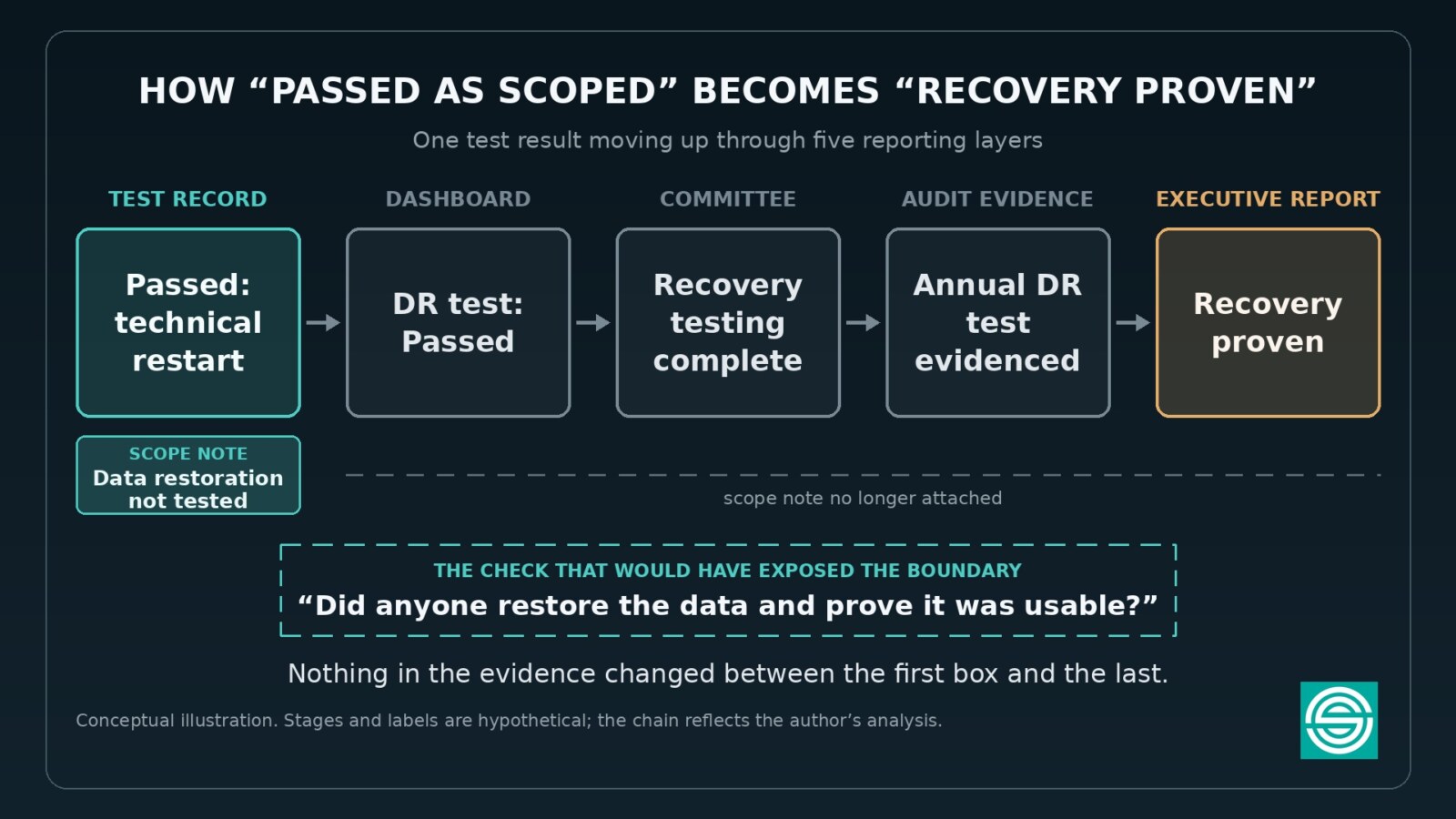
Did anyone restore the data and prove it was usable?
The answer was no.
“Passed as scoped” can be entirely legitimate. But the scope must travel with the result. If the test proved technical restart, report technical restart. Do not allow that result to become “recovery proven” as it moves through dashboards, committees, audit evidence, and executive reporting.
False Green Is a Decision Error
For months, the process appeared controlled. Tests were completed. Reports existed. Review continued. Status remained green.
No one had to decide to skip restoration. The assurance system had normalized a substitution:
technical restart became recovery.
That is a false green: genuine positive evidence inside a narrow boundary, interpreted as proof of a wider untested capability.
The danger is not the color. It is the decision made from it.
When leaders are told that recovery testing passed, they may reasonably believe the service can be recovered. When the underlying evidence proves only technical restart, those leaders are deciding on a premise the evidence does not support.
UK supervisors have described a related problem from the board's side. Reviewing firms' annual self-assessments after the operational resilience transition period ended in March 2025, the Financial Conduct Authority, the UK's conduct regulator, found that some firms state there is no scenario they could not recover from, without evidence of testing against sufficiently severe scenarios. Among the good practice it observed was documenting test assumptions clearly enough for boards to challenge them. The Prudential Regulation Authority, the Bank of England's prudential supervisor, continues operational and cyber resilience assessments in 2026/27.
US guidance points more directly at the check this case missed. The sound practices that the federal banking agencies (the Federal Reserve, the OCC, and the FDIC) set out for the largest US banking organizations, issued in 2020 and revised in June 2026, describe a firm that backs up critical data and regularly tests those backups for completeness and reliability, with reporting to senior management and the board that supports timely decisions in a disruption. The paper compiles existing guidance rather than creating new requirements.
None of this validates the case here, and each source applies only to defined sets of financial firms. Together, they show that the gap between a recovery claim and the testing behind it is a supervisory question, not only an internal one.
Write the Finding at the Level of the Failed Capability
A narrow finding might say:
Backup jobs failed to store usable data, and monitoring did not detect the condition.
Correct, as far as it goes.
A stronger finding would say:
The organization had not demonstrated that the application could be recovered, because recovery testing and monitoring did not verify restoration of usable data. Existing evidence supported confidence in backup activity and technical restart, not recovery.
The stronger finding still requires the backup defect to be fixed. It also identifies the assurance failure that made the defect a surprise.
That changes how far the fix has to reach.
Let the Remediation Boundary Follow the Finding
If the finding stops at the component, remediation has no reason to go further.
A complete response should address:
- the backup mechanism and its monitoring;
- the design and coverage of recovery testing;
- whether each test result carries its scope with it;
- the dashboards and reports that conveyed assurance;
- the governance questions asked before accepting green status; and
- the conditions required before recovery can be claimed.
Component repair fixes the backup. It does nothing for the belief that hid the failure.
Five Questions Before Closure
Before closing a material incident, leaders should be able to answer:
- What visibly failed?
- What did the investigation establish beyond the visible defect?
- What did the available evidence prove—and not prove?
- Which decisions relied on the belief the incident disproved?
- Who owns remediation beyond component repair, and how far must it reach?
These questions do not turn every technical incident into a systemic crisis. They keep the final finding open long enough to learn whether the visible failure was the whole failure.
A Scope Statement That Travels
The five questions close this incident. Preventing another false green starts with the next test.
Attach a short scope statement to every recovery-test result before it leaves the test team:
- Objective: what the test set out to show.
- Demonstrated: what was proved, in plain terms—for example, technical restart.
- Not demonstrated: what was outside scope—for example, restoration of usable data or safe resumption of the business service.
- Conditions and limits: the environment, data, and timing assumptions behind the result.
- Before recovery can be claimed: what must still be shown, and by whom.
- Owner: who signs the statement and who carries it upward.
Its job is to keep “passed as scoped” from becoming “recovery proven” on the way up.
The Decision That Follows the Green
The backup failed. It had to be repaired.
But the organization also had to correct the assurance system that treated activity as capability and technical restart as recovery.
That is why the final finding matters.
It does more than describe what happened. It governs what the organization is prepared to fix—and whether the next green result deserves to be trusted.