
Many years ago, I was sailing a catamaran with my brother. We could see a storm in the distance.
We sailed toward it.
As the wind increased, the boat came alive. I remember leaning backward against the force, feeling the hull respond and hearing the bow begin to hum. The entire vessel was interacting with something far larger than itself.
It was exhilarating. It also gave me a distinction I keep returning to when I think about artificial intelligence.
The destination was not the wind. The wind was the environment. The challenge was learning how to sail.
What stays with me is the relationship between the force, the vessel, and our response.
Organizations often describe AI as something to reach: a milestone, a strategic objective, a new identity. But completing an AI implementation and becoming capable of navigating an AI-shaped environment are different achievements.
The implementation can finish. Navigation continues.
For years, I have been uncomfortable with the way technology discussions so quickly become conversations about arrival. How do we implement it? How do we adopt it? How do we become an AI company?
Those questions have a place. A defined project needs an outcome, a budget, and a point at which someone can say it has been delivered. The difficulty begins when that completion is mistaken for the end of navigation.
I have seen this before. Mainframe to PC. PC to distributed systems. Data centers to cloud. Each transition had its go-live dates, and each was declared done. In my experience, what decided the outcome came afterward: whether the data stayed sound, whether someone owned the changed process, whether controls kept pace, whether vendors were still overseen, and whether people knew when to override the system.
You do not set the sails once and forget them. Wind direction changes. Wind strength changes. Sea conditions change. The boat responds, and the crew has to respond with it.
I find that a more useful way to think about organizational readiness for AI. The question becomes: how do we maintain the ability to respond when the conditions on which our decisions depend change?
NIST’s voluntary AI Risk Management Framework places risk management throughout the AI lifecycle and recognizes that changing data can affect a system’s functionality and trustworthiness. That supports the need for continuing attention after implementation. The framework is itself being revised as part of the White House AI Action Plan.
An organization can complete an implementation. It still has to learn from what happens next.
The course is still yours
No sailor controls the wind. But that does not make the sailor powerless.
The same distinction matters here. An organization may have little influence over the wider direction of AI development. It still makes choices about what to use, where to use it, which decisions to delegate to a system and which to keep, and when to change course.
Understanding AI as an environmental force does not remove responsibility. It makes the response central.
Instead of asking only how to implement AI, leaders can ask how to build an organization capable of learning from its use. Can people challenge assumptions? Can they absorb new information? Can they revise a decision when its basis changes? Can they experiment without losing sight of the consequences?
These are organizational capabilities. Buying a technology does not, by itself, demonstrate that they exist.
What the force amplifies
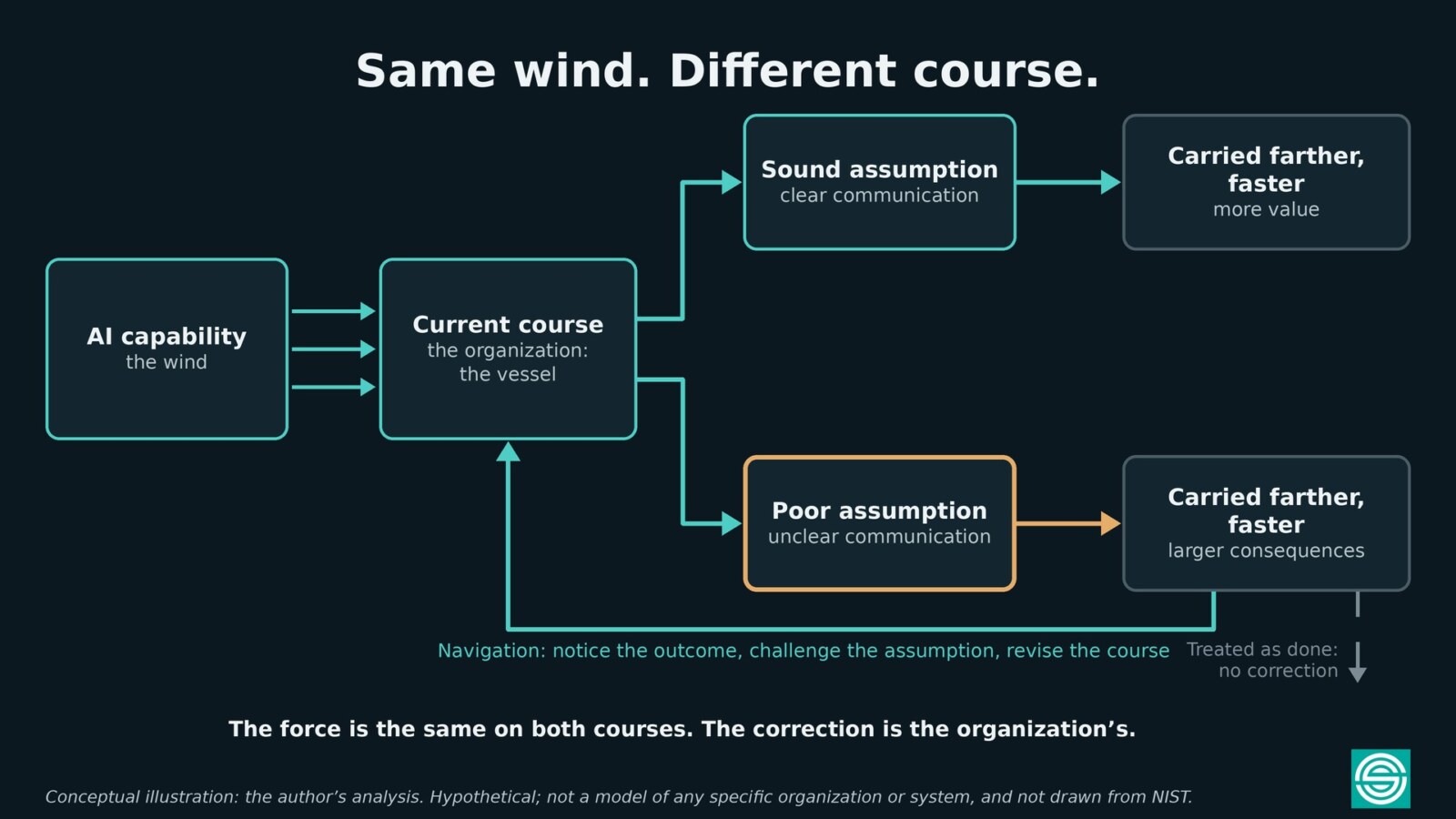
I increasingly think of AI as a force multiplier. In sailing terms, that is what wind is. It does not choose a heading. It adds force to whatever course the vessel is already on.
Increasing AI capability does not repair the conditions in which it operates. If a decision rests on a poor assumption, extending its reach extends the consequences. If communication is unclear, accelerating it carries the ambiguity farther.
The same holds in the other direction. A sound decision or a clear message, carried farther and faster, is worth more. What is amplified depends on the technology, its use, and the organization around it.
That is why resilience, governance, communication, and decision quality belong in this discussion. They help determine how an organization responds to the force it is trying to use.
The stronger the wind becomes, the more important the integrity of the vessel.
The capability to keep adjusting
My argument is that an organization able to learn and change course is better positioned to navigate uncertainty than one that treats implementation as sufficient preparation.
That does not mean chasing every new tool. Constant activity is not the same as navigation. The question is whether a change in conditions can lead to a considered change in response.
The organizations I would put my confidence in will not be the ones that declared they had arrived. They will be the ones still trimming the sails.
AI is worth taking seriously enough to question how we describe it.
The destination was not the wind. The wind was the environment. The challenge was learning how to sail.