
AI is not being introduced into a clean enterprise.
It enters the processes people use every day, the spreadsheets they maintain, and the workarounds that keep operations functioning. Together, they may differ considerably from the organizational picture: the records, measures, and process maps that describe how work is supposed to happen.
A workflow can complete while leaving weak handoffs. A dashboard can report a number without establishing what that number means. A process map can describe the intended route while people manage exceptions somewhere else.
AI inherits those differences too.
Before deciding what AI can do for the organization, ask an earlier question: what are we asking it to inherit?
When the tool becomes the procedure
Procedural automation is supposed to make defined work more consistent. Rules are configured, steps are enforced, and required information is collected. That can improve reliability.
But when the underlying work has not been adequately described, the software can fill the gap. The screen flow becomes the process. The required fields become the control. The configured approval path becomes the way people understand authority.
The tool becomes the procedure.
Operating knowledge then sits inside configuration, code, integrations, user habits, and workarounds. In my experience, each platform shift, from mainframe to distributed systems to cloud and SaaS, left some of that knowledge where the documentation never reached. The system runs, so its operation can look settled. Yet execution alone does not establish that the organization understands the process or has governed it effectively.
Consider the kinds of seams that can remain: a spreadsheet reconciles two systems; a manual review handles exceptions the workflow cannot accommodate; a report supplies an executive number whose meaning is no longer examined.
Each may solve an immediate problem. Together, they can make the organizational picture increasingly incomplete.
When different teams own requirements, control design, decision rights, exception handling, testing, measurement, monitoring, and recovery, and no one reconciles their assumptions, the organization can end up with automated fragments and manual seams.
Humans become the integration layer. They know which records need correction, which approval requires a conversation, and which exception never appears on the dashboard.
That work matters. An efficiency initiative that cannot see it may eliminate what keeps the operation running.
AI begins to interpret that environment
Procedural automation follows configured rules. A generative AI application can also be asked to summarize documents, explain results, classify exceptions, or propose actions. The difference is not absolute, but it is practical: those uses place it closer to how the organization interprets its work.
Which exception deserves attention? What does this control assessment establish? Which recovery option appears workable? What information should influence the next decision?
An answer may depend on documentation, inventories, metrics, and assumptions that the organization has not adequately tested. The AI application may have no access to the manual intervention that made a workflow succeed or the unresolved disagreement behind a reported number.
It can still produce an explanation.
That is the central concern: a convincing explanation can make an incomplete organizational picture easier to believe.
A convincing explanation is not verification
AI can summarize unclear documentation without resolving its ambiguity. It can organize inconsistent records into a readable narrative without establishing which record is authoritative. It can recommend action from a process map without proving that the map reflects actual work.
The output may be useful. It may also give weak premises a stronger presentation. NIST's Generative AI Profile makes a related point: generated outputs can include logic or citations offered to justify an answer, which may lead people to trust it more than they should.
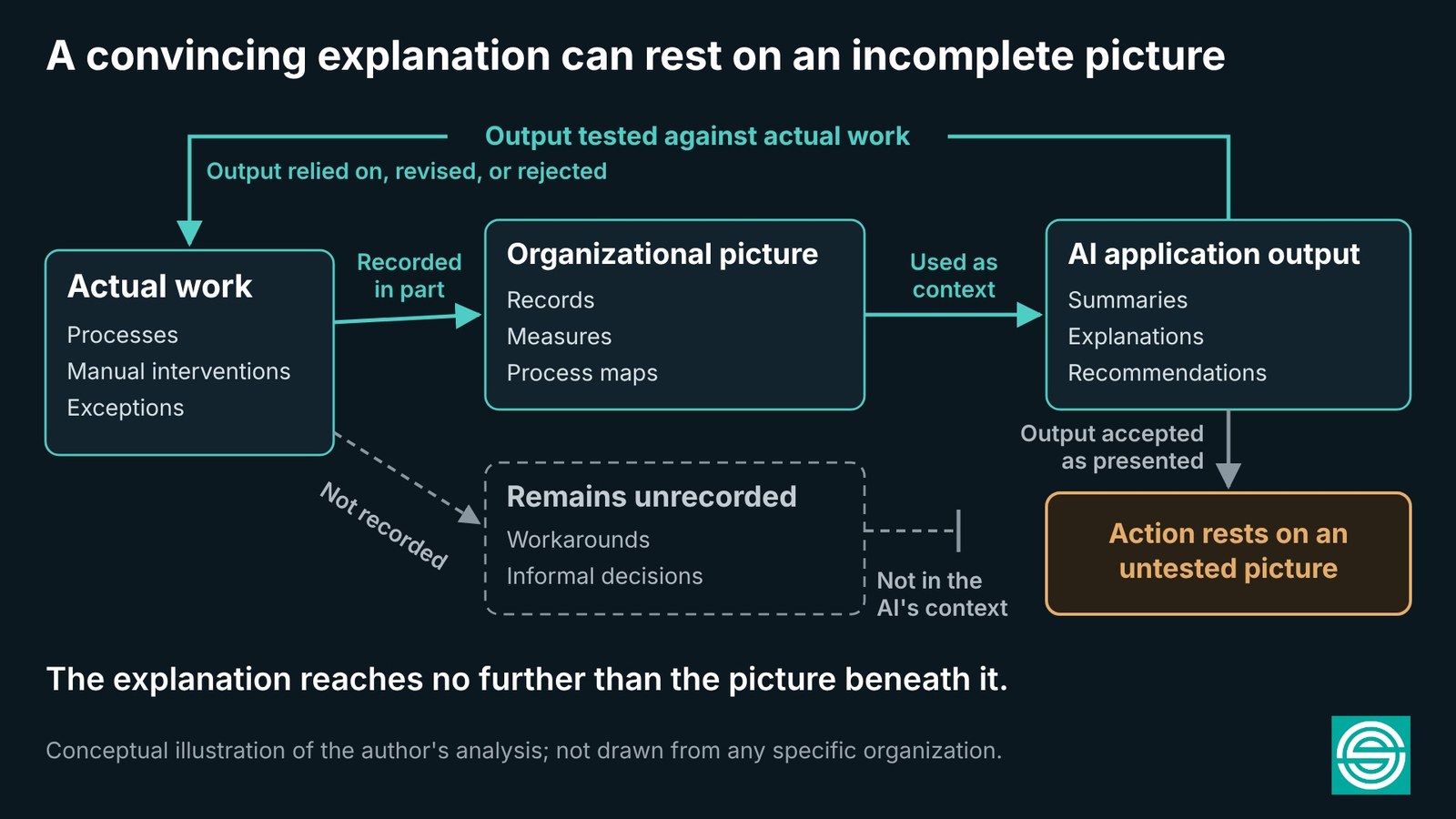
Before accepting the answer, the question is not whether it sounds reasonable. It is this:
Why should we believe the organizational picture the AI is being asked to reason from?
That question applies to the KPI, recovery plan, control rating, architecture diagram, data source, and decision rule. What does each one establish? What does it omit? What evidence would show that it is wrong?
Model accuracy, privacy, security, monitoring, and human oversight remain necessary. They do not, by themselves, establish that the surrounding operating assumptions are sound.
NIST's AI Risk Management Framework treats context as part of AI risk management. Its MAP function addresses intended use, assumptions, limitations, and system requirements; its GOVERN function addresses roles, responsibilities, and accountability; its MEASURE function calls for AI output to be interpreted within its context. That supports examining the environment around the system.
This is an organizational problem as well as a model problem. An application can perform its assigned task adequately and still support a poor decision if the task rests on an untested picture.
Adoption and readiness are different standards
Adoption means the tool is being used. Readiness means the organization understands enough about the work, evidence, controls, and decisions surrounding that use to judge its outputs and act responsibly.
It does not require the organization to finish documenting everything before using AI. It requires understanding what matters for the particular application and identifying what remains uncertain.
Start with the actual work:
- Where does it happen, and which systems does it depend on?
- Where do people intervene or handle exceptions outside the recorded process?
- Which measures determine success, and what do those measures establish?
- Are controls embedded in execution, or is evidence reconstructed afterward?
- Who owns the decision, what evidence is required, and what would invalidate the recommendation?
These questions connect performance to governance. They can reveal rework, ambiguity, weak handoffs, and decisions whose ownership has never been made explicit.
Speed does not resolve those conditions. It can increase their consequences. An application may help optimize a weak signal, automate a poorly understood process, or generate more convincing language around a superficial control.
The practical response is to set scope by what each use would speed up. Some work may be ready for broader use. Other work may need reconciliation, clearer boundaries, or additional review first. Strong results in one area do not establish readiness in another, and a weak process does not rule out AI everywhere.
The inheritance is also an inventory
The opportunity is larger than avoiding poor outputs.
Examining what AI inherits can expose what earlier automation concealed: unnecessary reconciliation, duplicated work, misleading measures, unclear responsibilities, or operating knowledge held by people whose contribution is absent from the process map.
Those findings can improve performance even before an AI application is expanded. Fixing them can reduce friction and clarify accountability at the same time.
AI may assist that examination by helping compare records, organize inconsistencies, or identify questions for people who understand the work. Its contribution still needs testing against the actual work. An explanation of a discrepancy is a starting point for investigation, not proof that the discrepancy has been resolved.
The aim is to expose, test, and improve the organization before AI is asked to carry more of it.
Understand what is being accelerated
AI inherits the organization it finds.
Where work, evidence, controls, and responsibilities are sufficiently understood, AI can extend that strength. Where they remain fragmented or ambiguous, its outputs can carry those weaknesses forward. The technology alone guarantees neither outcome.
The first question is old: do we understand what we are operating?
Answer it with enough discipline for the intended use. Otherwise, AI may simply accelerate what it inherits.