
A company can be compliant and still be unready.
That is an uncomfortable sentence to say out loud in a regulated environment. Compliance matters. Documentation, controls, testing, and audit trails create discipline and give people something to inspect.
But evidence that a process was followed is not proof that the organization can perform under stress. A completed test can establish one capability while leaving another unexamined. Trouble begins when the result is reported as if it established both.
The organization looks prepared. The capability it is relying on may still be unproven.
The Binder Can Be Complete
The policy is there. So are the recovery plan, test results, screenshots, issue log, and sign-offs. Producing that package takes work. It coordinates people, records decisions, and makes review possible.
Yet the binder can be complete and the capability still untested.
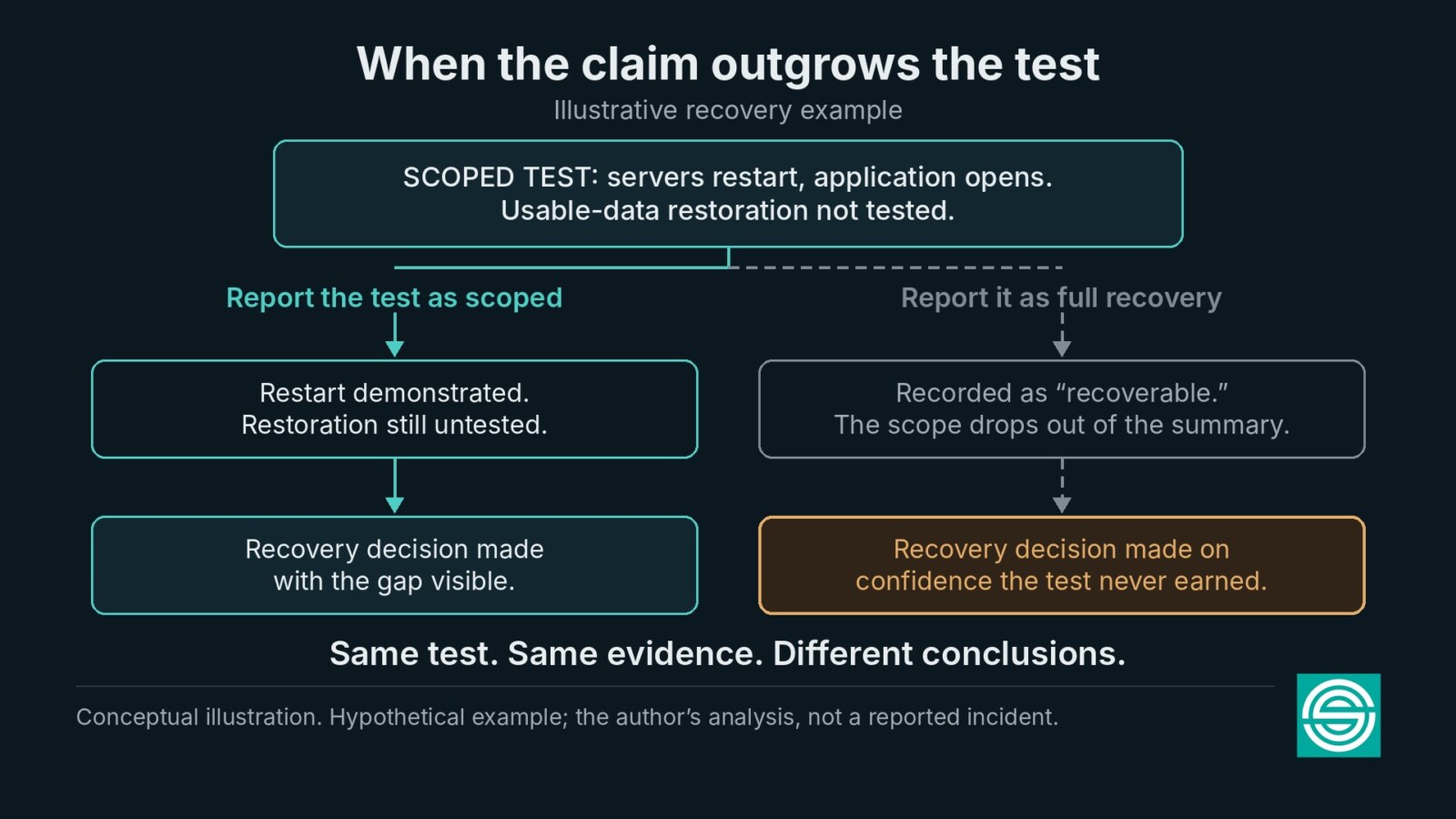
A critical application can pass a disaster recovery test because the servers restart, the application opens, and someone takes a screenshot. If the exercise does not restore usable data, the organization can still discover during an incident that its backups cannot support recovery.
The exercise and its evidence may be real. They still do not establish the broader recovery capability.
At that point, the organization believes it can recover; what it has demonstrated is a restart. The gap lies between what was shown and what was inferred.
Evidence Is Not the Same as Assurance
Evidence makes review, challenge, and accountability possible. It becomes a liability when it is allowed to imply more than it proves.
A backup report showing that a job ran does not demonstrate that usable data can be restored. A test limited to server restart does not demonstrate that the operation it supports can safely resume. An approved policy records an accepted approach; execution under incident conditions still needs examination.
The same distinction applies elsewhere. Completing a vendor review does not, by itself, establish that critical dependencies were understood. Recording a human approval does not establish that judgment was exercised.
The evidence can be entirely valid. The failure lies in what is concluded from it.
Proof of one thing becomes confidence in another. Activity becomes capability. Documentation becomes readiness. Approval becomes judgment.
No one has to decide to replace resilience with paperwork. Evidence can become standardized, reporting familiar, and review cycles predictable. As the qualifications disappear from the summary, the organization can become comfortable with a claim the underlying work never established.
The Test Passed As Scoped
“As scoped” is a necessary qualification. A test cannot examine everything. Scope makes the work manageable and tells people how to interpret the result.
If the test validates infrastructure restart, say that. If it validates application startup, data restoration, or full operational recovery, identify which capability was demonstrated and under what conditions.
The risk enters when a narrow result is reported, remembered, or governed as a broader assurance.
Was usable data restored? Were users involved in business validation? Were downstream interfaces, reconciliation steps, manual workarounds, and controls in the recovered state included? Was the recovered operation safe to use?
An exclusion does not make the test worthless. A startup test has value. The result misleads only when it is treated as evidence of recovery beyond that scope.
The FFIEC’s Business Continuity Management booklet describes testing that includes transaction processing, infrastructure, capacity, data integrity, and dependencies. Those are different questions from whether an application opened. The distinction matters when deciding what the test result permits leaders to conclude.
Scope should clarify assurance, not inflate it.
A Closed Workflow Can Leave the Risk Open
Forms, signed approvals, completed test scripts, and closed findings create administrative closure. That closure is useful when the underlying question has been answered.
But a completed compliance artifact can close a workflow without closing the risk.
The plan was updated. The test was conducted. The evidence was uploaded. The ticket was closed. Each statement may be true while the operational question remains unanswered: can the organization do what the artifact suggests it can do?
That means restoring the data, identifying the dependency, communicating accurately, and resuming the operation safely, with people executing the approach under pressure.
The process needs evidence of completion. The recovery decision needs evidence of capability. One cannot stand in for the other.
Performing for the Review
A team can become very good at preparing for review. It learns which screenshots are expected, which fields need completion, and which sign-offs close the loop. That familiarity can improve discipline.
It can also narrow attention. The exercise becomes organized around the evidence package, and the question shifts from “Can we recover?” to “Can we show that the recovery test was completed?”
The second question has one great advantage: it can be answered. It asks whether a defined workflow finished, rather than whether the critical operation can continue through disruption.
When preparation centers on a predictable script, the review may be satisfied while the capability remains uncertain. That can happen simply by testing familiar actions and leaving the difficult operating condition outside the exercise.
Demonstration Under Conditions That Matter
Having a plan, an approved strategy, or completed tests is useful. None alone demonstrates how the organization will perform under the conditions it may need to withstand.
The Basel Committee’s Principles for Operational Resilience address banks’ ability to deliver critical operations through disruption. Principle 3 calls for exercises under severe but plausible scenarios, with critical operations and their interdependencies included in the testing approach.
That is banking guidance. It certifies no one’s readiness, and the implications that follow are this article’s, not the Committee’s.
Depending on the operation and the disruption, meaningful demonstration may involve restoring usable data, operating from an alternate site, testing manual processes at the volume they must handle, or communicating clearly while facts remain uncertain.
It may also reveal that resumption would be unsafe. In that case, the decision becomes whether to continue a controlled workaround, suspend an affected operation, or explicitly accept residual risk. Discovering that the plan does not work can be a valuable result if the organization acts on it before an incident forces the lesson.
An exercise cannot guarantee performance in every future disruption. It can give leaders a more defensible understanding of what worked, what failed, and what they still do not know.
The Dangerous Comfort of Green
A dashboard can focus attention, summarize complexity, and create accountability. Executives need summaries; they cannot inspect every operational detail.
That puts a great deal of weight on one color.
If green means the policy exists, it should not be read as demonstrated capability. If it means a test was completed, it should not be read as full recovery. If it means a backup job ran, it should not be read as restorable data.
A reassuring status can suppress the uncertainty that should accompany a decision. The answer is not fewer dashboards. It is a measure that shows its own limits.
Compliance Still Matters
Organizations need standards, records, accountability, repeatability, and external challenge. Compliance helps preserve those things through personnel changes, scrutiny, and post-incident review.
What goes wrong is not compliance. It is compliance evidence that has drifted away from what the organization can actually do.
Good compliance can force clarity, expose assumptions, and create pressure to test, remediate, and improve. But when artifact production becomes the endpoint, a test can become a calendar event and an approval can become closure before the capability has been examined.
The artifact should point to the thing. It should not become the thing.
What Does the Evidence Prove?
Leaders should ask what the evidence proves and what it does not prove.
A startup-only test leaves restoration unanswered. A vendor questionnaire can leave unexamined whether the vendor could be replaced if it failed. A recorded approval can leave meaningful oversight unproven. The better response is to identify the missing evidence rather than dismiss what was actually established.
Bounded evidence is useful. Overstated evidence is dangerous.
The binder may be complete, the dashboard green, and the test passed. The question remains whether the evidence proves the capability the organization believes it has.
A company can be compliant and still be unready.
When the incident comes, the organization will need that capability. The completed paperwork can help people find it, understand it, and execute it. It cannot perform in its place.