
The failover was declared complete. It had gone almost too smoothly.
The command center at a bank was fully staffed. Every team reported green. No alarms.
About an hour in, posts started appearing on social media. ATM transactions were taking dozens of seconds instead of two. Customers said lines were forming at branches.
Nothing in the monitoring agreed.
We escalated anyway.
We didn’t have a complete story, but customer service and reputation were being damaged by the minute. Even so, the delay was significant, and there were regulatory consequences.
Afterward, we tried several times to reproduce the problem and couldn’t. The cause remained uncertain.
Nothing on the dashboards was wrong. The picture was incomplete.
Why Palantir Is Here
Palantir’s stated mission is software for institutions making decisions with real consequences. Its published ontology links operational data, decision logic, permissions, and actions. It can represent tasks, dependencies, and what follows from a decision.
Other platforms pursue related goals. I use Palantir because its architecture makes the question concrete: what happens when the model is coherent, but the operation has changed in a way the model doesn’t yet show?
The U.S. Army’s account shows where the gap lives. In 2025, at Al Asad Air Base in Iraq, Army aviation planners were copying planned routes by hand from their mission-planning system into the common operating picture in Maven. The picture everyone relied on depended on a manual step that sat outside it.
The soldiers doing the work saw the problem. Over several months, soldiers worked with their division’s data team and Palantir field service representatives on the gap.
A workaround routed the plans through another system and was functional, but the commander wanted a better solution. A sergeant was assigned to lead the effort to import mission files directly.
The Army’s account says the gap was identified during an exercise. It does not establish what the platform could or could not have detected on its own.
People close to the work identified the issue, and their leadership supported the effort to improve the process. That’s the pattern this article is about.
When the Picture Misses the Work
A report can be accurate about what it measures and still miss what matters. In that failover, the monitoring measured what it was built to measure. Customers were measuring something else.
The discrepancy often shows up first close to the work, or outside it entirely. That observation has to be checked, connected to the decision it affects, and carried to someone who can act.
The organization can’t wait to repair the model before responding. It changes course while a response is still possible, then fixes whatever missed the condition.
When AI Speeds the Picture Into Action
This problem existed before AI. Now imagine the recommendation to hold course had come from a model fed by the same dashboards. It might have reinforced the hold-course recommendation, consistent with the indicators in the room.
AI can shorten the path from information to recommendation to action. When several actions rest on the same missing dependency, the error travels with all of them.
The faster that path, the more it matters to know where an input came from, how it was transformed, and what the model left out. A recommendation can be fully traceable and still incomplete about the situation.
Who Can Defend the Situation?
The liaison idea isn’t mine. Team of Teams (2015), by Stanley McChrystal and his coauthors, describes a task force that built shared awareness across organizational boundaries. In One Mission (2017), Chris Fussell and C.W. Goodyear extend that team-of-teams approach to organizations.
My proposal gives the liaison a specific decision function: verify and defend evidence that conflicts with the reported picture, then carry it to someone able to act.
In my experience, it is uncommon to find someone in a corporate setting with the standing to defend a finding that conflicts with a trusted report, cross hierarchies to get it verified, and bring response choices to the decision owner while there’s still time to act. That narrower job is the one I’m proposing.
Isn’t that already someone’s job? Not quite.
Second-line teams and internal audit can challenge an operating picture; their mandates and timing vary. The proposed liaison is accountable for routing a specific, time-sensitive discrepancy to the decision owner during an event. In a failover, a later finding alone cannot shorten the lines at the ATMs.
Palantir’s forward deployed software engineers and deployment strategists come closer to the work. Their published descriptions emphasize working with customers to solve operational problems. I would place responsibility for independent challenge and escalation inside the decision-making organization.
That liaison works with the platform team when a gap calls for a fix, while retaining a route to the decision owner when the organization must act before the fix is ready.
In that command center, escalating meant arguing against every dashboard in the room with posts and rumors. The liaison function exists so that argument has a route, a standard of evidence, and someone with the standing to make it while it can still shorten the delay.
When AI shapes the recommendation, part of that job is making sure someone can trace what went into it and what it left out.
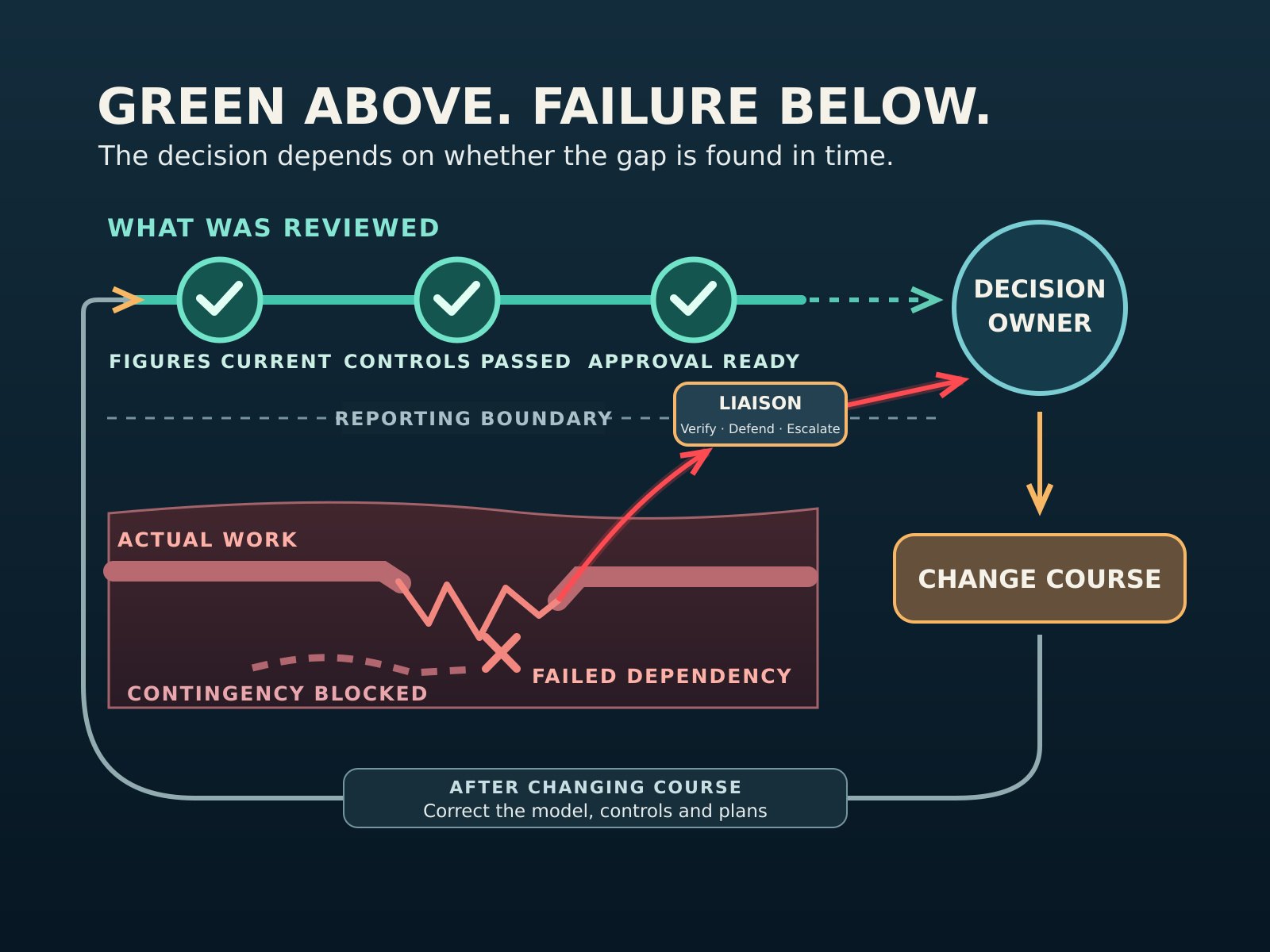
Where the Decision Can Break
1. What changed in the operating situation?A dependency becomes unavailable. A handoff fails. A contingency can’t be used as planned. The first test is whether anyone recognizes that the change affects a pending decision, even when the reported status hasn’t moved.
2. Can the evidence reach the decision owner in time?The person who sees the change needs a route across reporting lines. The escalation should carry what was observed, why it matters, and how much time remains. An exception recorded after approval can’t redirect that approval.
3. What can the decision owner do now?The owner needs authority and usable options: pause an approval, activate a tested contingency, bring in missing expertise, or choose another course, while it can still affect the outcome.
4. What changes after the response?Compare the assumptions behind the decision with what happened. Assign an owner to fix the model, procedure, control, or contingency plan that proved inadequate. Test the fix with the people who must use it before relying on it again.
The Test Before the Next Decision
Choose one consequential decision still ahead of you. Ask its owner: if the situation changed while the indicators stayed green, who could show you the evidence in time to change course?
Then walk through your last three exceptions or tests. Where did the evidence originate? What did the system show? Who could challenge that picture and defend the finding? What could the owner still do? If AI helped form the recommendation, trace its inputs and what it left out.
If the evidence in all three reached the decision owner while an effective response remained possible, you may not need a new role.
If they didn’t, the green is telling you less than you think.
A connected model can help people act on what the organization knows. The test is whether evidence from the work can change that picture, and the decision, while action is still possible.