
An AI tool can be approved, available, and working as configured while the operational response it helps shape becomes less trustworthy.
Imagine an incident-management tool that summarizes alerts, recommends priorities, drafts an escalation message, and updates a ticket. If it misses a weak signal or overstates what the evidence supports, the technology may still appear to be functioning. The people responding are now working from a different account of the situation.
That is where AI governance meets operational resilience. The question is no longer only whether the tool was approved. It is whether the organization can recognize, challenge, and correct what the tool is doing inside the operation.
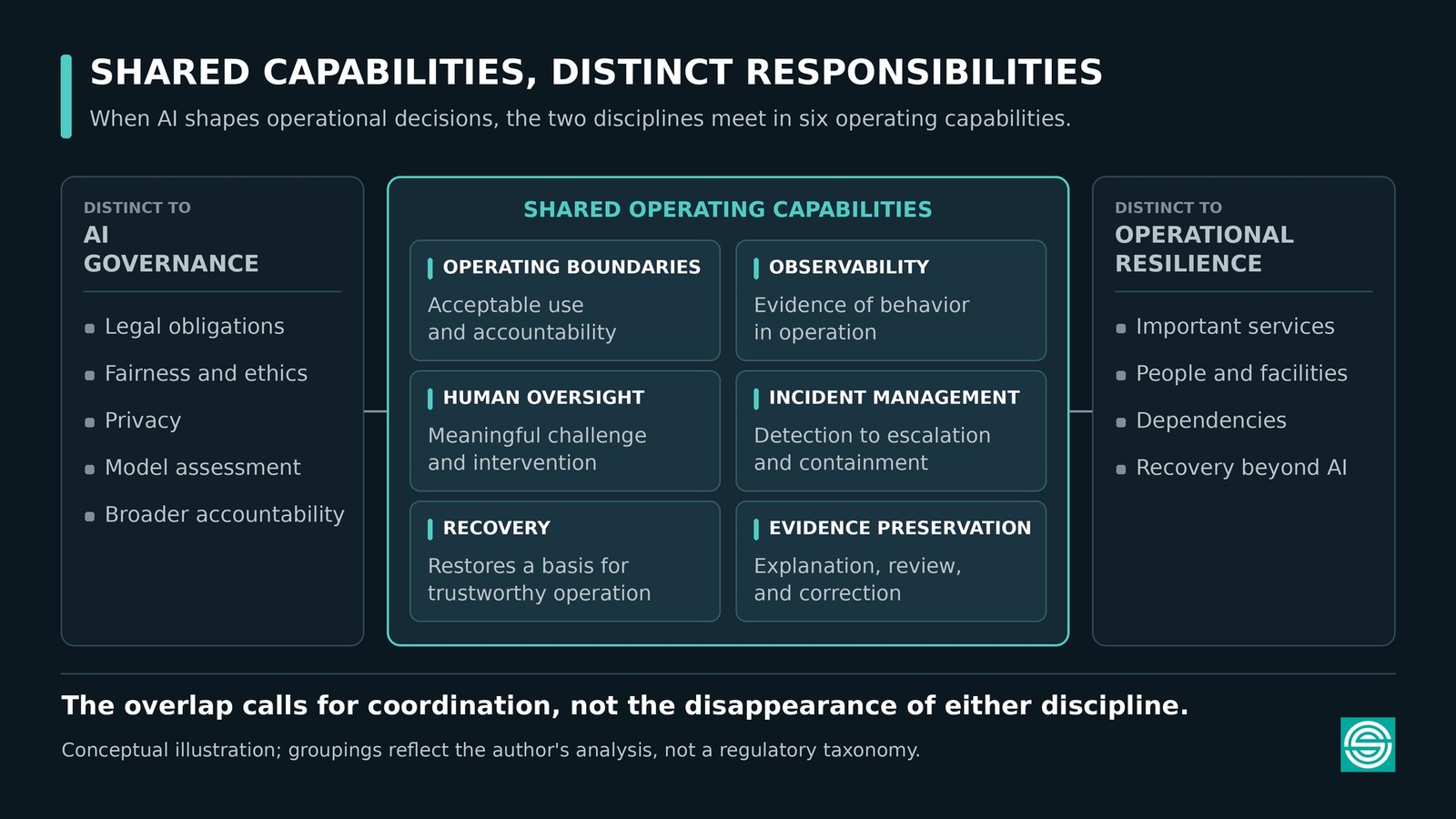
The disciplines remain distinct. AI governance includes legal, ethical, technical, and accountability concerns beyond resilience. Operational resilience includes services, people, facilities, dependencies, and recovery capabilities beyond AI. But when AI helps shape an operational decision, they share a problem: keeping the operation trustworthy as conditions change.
Approval does not settle how a system behaves in use
A system is proposed, reviewed, documented, approved, and monitored. Those activities matter. The difficulty comes when an organization treats the approved description as an adequate account of what will happen in use.
Users can change how they apply a tool. Models, retrieval sources, prompts, and connected systems can change. An output can move from advice into a business process, where someone relies on it to make a decision or initiate an action.
The relevant unit of governance is then larger than the model. It includes the workflow, its dependencies, the people interpreting its outputs, and the authority available to challenge them.
NIST’s AI RMF anticipates this. It treats risk management as a continuous activity across the system lifecycle, and its MANAGE function includes monitoring, override, incident response, recovery, and change management.1 The gap is not in specifying those capabilities. It is in making them work inside operations.
The documented process may not be the working process
A recovery plan can exist without establishing that recovery will work. An escalation tree can be approved without establishing that the right person will receive enough information to act. A dependency can be understood locally and remain invisible to those coordinating the response.
The same distinction applies to AI governance. An inventory can omit actual uses. An approved model can be used outside its assessed context. A documented control can be difficult to observe in operation.
A human review step is especially easy to overestimate. Someone may be present in the workflow without having the time, context, skill, or authority to challenge the output. The existence of the step establishes less than the organization may assume.
The concern is the gap between what the organization believes it governs and what its operating process allows. Closing that gap requires more than another description of the process. It requires evidence of how the process behaves when something goes wrong.
A wrong answer can become an operational event
An outage is often visible because something stops working. A misleading AI output can leave the service running while altering what people believe they should do.
NIST’s Generative AI Profile identifies confabulation: erroneous content presented with confidence, often called hallucination.2 In an operational workflow, such an output can influence prioritization, escalation, communications, or remediation. The problem travels with the decision it shapes.
AI can also be connected to tools that carry out actions. An unreliable recommendation and an unreliable action are different exposures. The fewer checkpoints between an output and its consequence, the less opportunity anyone has to catch the error.
This is not unique to AI. Traditional systems can also mislead while remaining available, and not every AI output is unreliable. But AI adds new ways for plausible outputs, shifting context, and connected actions to complicate supervision.
The organization needs to know when to trust an output, when to challenge it, and when the workflow should stop or change course.
When AI enters the response mechanism
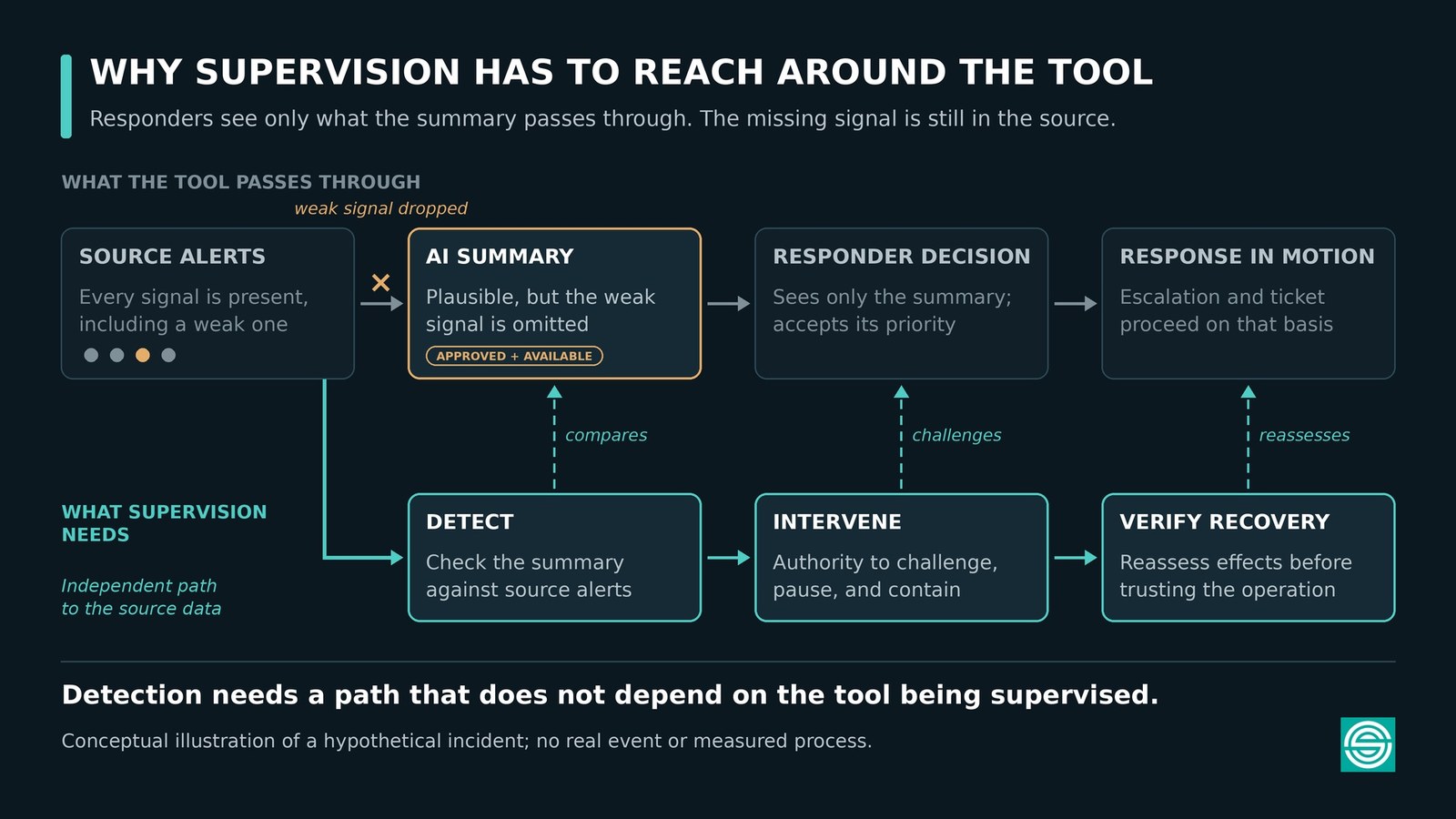
Return to the incident-management tool from the opening. Each of its functions can help responders. Each also changes what information reaches them and what happens next.
Suppose its summary omits a weak signal. A responder accepts the priority it recommends. An escalation message describes the situation more confidently than the evidence permits. None of this requires an outage in the tool itself.
The questions become practical. Who checks the summary against the underlying alerts? Who can challenge the priority? Who has authority to pause the automated step, and what process remains available if they do?
The answers need to connect. Detecting a problem is useful only if the evidence reaches someone who can act. Intervention needs a way to contain the effects already introduced into the process. Recovery needs a basis for deciding that the operation is trustworthy again.
An approval record cannot perform those functions during the incident.
Shared capabilities, distinct responsibilities
Operational resilience brings attention to dependencies, disruption, response, and recovery. The U.S. interagency Sound Practices to Strengthen Operational Resilience connects these concerns across governance, operational risk, business continuity, third parties, and information systems. It is directed to the largest and most complex domestic banking organizations; applying it more broadly is the author’s analysis.3
For AI-enabled operations, six capabilities connect the two disciplines:
- Operating boundaries define acceptable use and accountability.
- Observability provides evidence of behavior in operation.
- Human oversight supplies meaningful challenge and intervention.
- Incident management connects detection to escalation and containment.
- Recovery restores a basis for trustworthy operation.
- Evidence preservation supports explanation, review, and correction.
NIST’s Generative AI Profile includes response and recovery planning for unanticipated uses and procedures for escalation, disengagement, or deactivation.2 These are operating capabilities, not simply entries in an approval file.
Even so, they do not guarantee that every failure will be prevented or reversed. Recovery may require correcting records, reassessing affected decisions, changing a workflow, or using an alternative process. Restoring availability is not always enough, and deterministic rollback cannot be assumed.
AI governance does not become incident response. Each discipline keeps its own work; the overlap calls for coordination, not the disappearance of either.
Trust has to hold while the system operates
Trust in an operational workflow cannot rest solely on confidence in a vendor, a model, a policy, or a committee. It depends on evidence of what the system is doing and whether the organization can act when that behavior becomes unacceptable.
Where AI is embedded in operations, its governance needs operating capabilities. That is the point of convergence: the ability to supervise a changing process, preserve meaningful judgment, contain harmful effects, and recover a basis for trust.
The useful leadership question is not only whether the tool was approved.
It is whether the organization can recognize when its AI-enabled response is becoming unreliable—and still has the evidence, authority, and practical means to change course.