
If we had paused before making the decision that seemed so right at the time, we might be in a much better place now.
The regret may follow a vendor selection, a technology rollout, a restructuring, or a strategic bet. Looking back, the organization can see an assumption it never examined or a dependency it treated as someone else's problem. At the time, neither was reason enough to stop.
The decision seemed reasonable. Urgent, perhaps. It matched what leadership wanted and appeared consistent with the information available.
The decision felt right at the time. That was the problem.
Not because confidence made the decision wrong, but because it made testing seem unnecessary. A decision can feel right before it has been tested.
When agreement stands in for testing
A proposal that looks weak gives people a reason to challenge it. They request evidence, compare alternatives, and ask what could fail.
When a decision feels right, the room can relax. Objections sound unnecessary. Alternatives feel like delay. Uncertainty becomes something to address during implementation. The decision begins to move because the discussion already feels settled.
The more obvious the answer appears, the less pressure there may be to test it. Urgency can make speed look like responsibility. Agreement can make a question about the premise sound like a question about the team's competence or commitment.
That is how confidence can replace testing without anyone consciously deciding to dispense with judgment.
There are good reasons to value decisiveness. Organizations cannot deliberate over every choice indefinitely, and delay can be its own failure. But avoiding paralysis does not require treating a consequential assumption as settled simply because nobody wants another discussion.
Consensus is not validation. Urgency is not proof. Alignment is not analysis.
A clean story can explain a decision without testing it.
How the decision becomes embedded
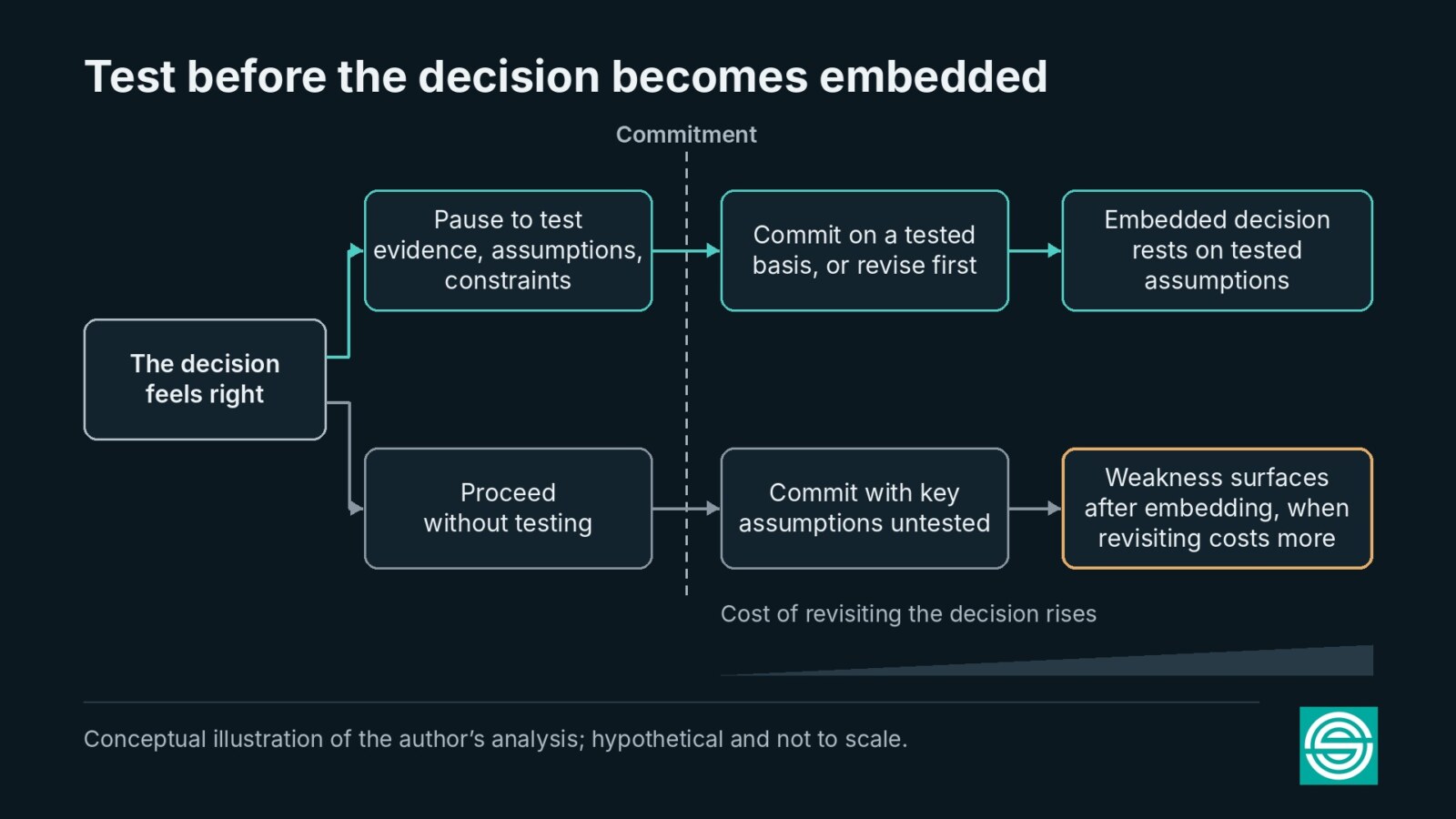
An untested assumption may not fail immediately. Implementation begins, dashboards look acceptable, and people find ways to make the decision work. Workarounds can obscure the weakness rather than resolve it. An early warning may be explained as a temporary implementation issue.
Over time, the decision becomes part of the operating environment. It shapes dependencies, budgets, procedures, and expectations. At that point, reconsidering it involves more people and more cost than testing it before approval would have.
Then the questions arrive. Why did we choose that platform? Why did we trust that assumption? Why did we ignore that dependency or accept the vendor's answer? Why didn't anyone stop us?
Because it felt right at the time.
That answer explains the comfort. It does not show that the decision deserved trust.
Nor does later disappointment prove that it was wrong. A sound decision can produce a bad outcome. The question is what the organization could reasonably have tested before committing, and whether it did so.
The pause before commitment
A decision that feels right may still be right. The point is to distinguish a strong conclusion from one that has never been tested.
Before committing to a consequential decision, ask:
- What would have to be true for this decision to be wrong?
- What evidence would change our mind?
- What assumption is carrying the most weight?
- What constraint are we treating as flexible?
- What alternative did we reject too quickly?
- Are we moving because the case is strong, or because scrutiny is inconvenient?
- Could we reconstruct this decision six months from now and explain why it deserved trust?
These questions are a disciplined pause, not an instruction to delay every decision. Their value is in testing what carries the decision, not in producing another document that records agreement.
The last question is about the record. A record should show the evidence considered, the assumptions relied on, the constraints recognized, and the uncertainty accepted. A persuasive explanation written afterward is no replacement for testing beforehand.
A pause is not hesitation when it prevents the organization from mistaking momentum for judgment.
A convincing answer still needs testing
The same distinction applies when an AI system recommends a course of action, a vendor presents a polished solution, or a dashboard shows an early improvement.
The model produced an answer. The demonstration worked. The numbers look good. Each observation may be useful. None, by itself, establishes that the proposed decision is supported in the setting where it will be used. Every earlier technology shift, from mainframe to cloud, carried the same lesson: a demonstration in the vendor's environment is not proof in yours.
For AI systems, NIST's AI Risk Management Framework 1.0 connects risk assessment to the intended context of use. Its MAP function, which frames that context, includes checking assumptions about it and identifying real-world constraints. Its MEASURE function, which covers assessment, calls for testing before deployment and regularly during operation (NIST AI RMF Core, sections 5.2–5.3).
Testing the AI system is one part of testing the decision that uses it. The organizational decision still depends on the purpose, the alternatives, the assumptions, and the consequences of commitment. A satisfactory technical result cannot answer all of those questions on its own.
The uncomfortable question belongs before agreement becomes difficult to revisit: have we tested the basis for this decision, or have we accepted the confidence surrounding it?
Turn regret into a decision practice
Decision integrity does not eliminate risk. Good judgment can still meet bad conditions.
What an organization can establish is whether a decision deserves trust when it is made: whether the evidence supports it, the assumptions carrying the most weight have been tested, and the constraints have been taken seriously.
If we had paused before making the decision that seemed so right at the time, we might be in a much better place now.
That sentence should become more than a regret. Before the decision becomes policy, architecture, budget, or an automated process, pause long enough to test why it feels right.
The decision may survive the test.
Good. Then move.
If it does not, the organization has learned something before commitment makes the cost of learning higher.
The problem is not that the decision felt right. The problem begins when feeling right is allowed to substitute for being tested.