
Everyone wants to build the bridge.
That is where the attention goes: the design, the ambition, the visible progress, the ribbon-cutting. There is something to fund, announce and photograph.
Inspection offers a less comfortable kind of progress. It asks whether the structure can carry the load people intend to place on it. The answer may interfere with the celebration.
The people who build the bridge are celebrated. The people who inspect it are tolerated.
At least until something fails.
Organizations face the same divide. Creating a capability and verifying that it can be relied upon are different parts of the work.
Why inspection becomes inconvenient
Inspection can feel like delay because it asks questions after momentum has formed. Is the structure sound? Were the materials what we thought they were? What happens under load, in bad weather, or when several small weaknesses interact?
Those questions do not produce another visible structure. They examine the one people are already invested in.
Budgets have been spent. Reputations are attached. Leaders want progress. Teams want credit for the work they have done. A finding that challenges the result can become uncomfortable for reasons that have little to do with its accuracy.
The problem begins when that discomfort determines how much scrutiny the work receives.
Verification gets compressed to protect a date. A test becomes a demonstration of the expected result. A warning is judged by the disruption it would cause rather than by the weakness it identifies.
After a collapse, the same questions look obvious. Suddenly everyone wants to know what the inspector found.
But the purpose of inspection was to make those questions useful before the consequences supplied the answer.
The capability exists. What has it demonstrated?
Consider the difference in a few organizational settings.
A new system launches. Adoption is tracked and the dashboard turns green. Yet the team has not tested how it performs under the stress the business may place on it.
A recovery plan has been approved and stored in the right repository. That establishes that a plan exists. It does not establish whether the organization can execute it under the conditions it is meant to address.
A control is documented and has an owner. The remaining question is whether it detects, prevents or limits the condition it was designed for.
A communication channel is established, with a meeting cadence and a reporting structure. The organization still needs to find out whether important information reaches someone who can act quickly enough when events begin to move.
In each example, something has been built. The question is what evidence supports relying on it.
Deployment is not the same as dependability. Documentation is not the same as capability. Confidence is not the same as evidence.
When those distinctions disappear, completion becomes a label attached to work whose operating limits remain unclear.
Verification protects what has been built
Inspection, testing, audit, quality assurance and governance have different responsibilities. They are not interchangeable. Their value here lies in the questions they can bring to a capability that is already being treated as dependable.
Done properly, that challenge protects the value of construction.
The Cybersecurity Framework 2.0 from the U.S. National Institute of Standards and Technology (NIST) provides a concrete cybersecurity example: improvements are identified from security tests and exercises, including those done in coordination with suppliers and relevant third parties.
The leadership implication is broader: a finding matters when someone acts on it. Discovering a weakness can change what the organization fixes, how it operates, or what it is prepared to rely upon.
A successful test also has limits. It supplies evidence about the conditions tested. It cannot guarantee performance under every future combination of events. Changes to a system or its dependencies may create a need to examine it again.
Trust should remain connected to evidence, including what the evidence does not cover.
Building and verifying belong to the same responsibility
Organizations have to build. They need new systems, processes and ways to serve clients and operate under pressure.
The difficulty arises when recognition goes mainly to creating those capabilities, while scrutiny is treated as resistance to their success. That arrangement gives people a reason to defend the appearance of completion when they need to examine the underlying performance.
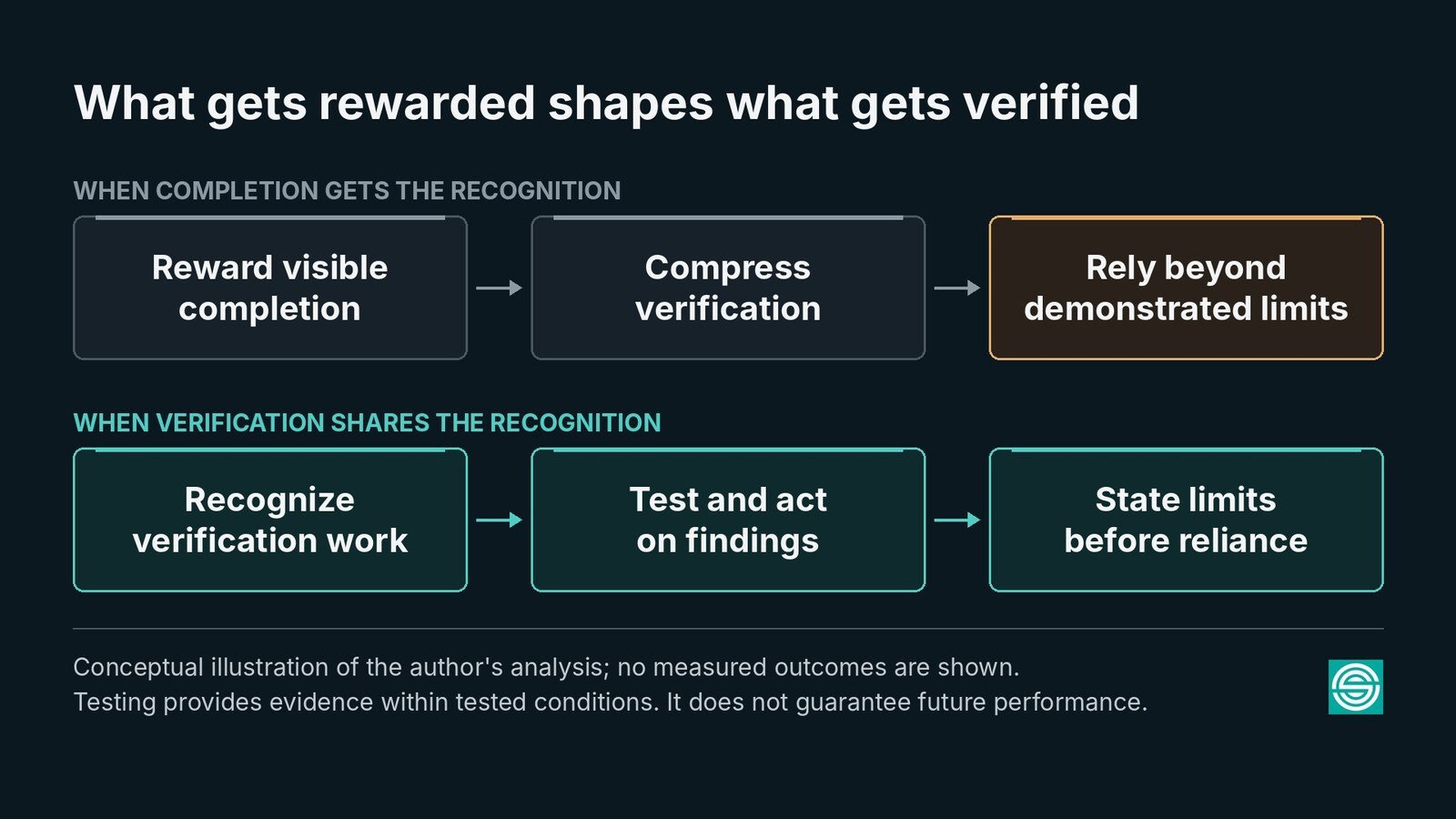
Verification needs a place in the work from the outset, with time to investigate findings and act on them. It should not depend on whether anyone still has an appetite for difficult questions at the end.
Before relying on a capability, leaders should be able to explain what has been tested, under which conditions, what remains unresolved and how those limits affect its use.
The bridge is not complete merely because it exists. There must be a defensible basis for trusting it with the load it is expected to carry.
That basis comes from inspection, testing and the evidence they produce, and from people willing to act on what they find.
Everyone wants to build the bridge.
The serious work is making sure it holds.