
The process completes. The dashboard stays green. The vendor delivers. The AI model produces a useful answer. Everything appears to be working.
Each result tells us what the system did under the conditions it encountered. The trouble begins when we treat that evidence as an answer to a larger question: how will it behave when those conditions change?
An approved recovery plan does not show whether a team can recover when a critical dependency is unavailable. A successful AI demonstration does not show what happens when credible sources disagree or the evidence cannot support the conclusion being requested.
Ordinary success can leave consequential questions unanswered. Structured examination makes those questions explicit and creates conditions in which we can observe the response.
Start with the question the demonstration did not answer
“Does the system work?” is a reasonable starting question. Its usefulness depends on what we mean by work, and under which conditions.
A tool may summarize a document accurately. That does not tell us whether it will acknowledge a gap in the source material. It may classify a ticket correctly without showing what it will do when the case crosses two teams’ responsibilities. It may recommend an action without demonstrating whether it will withhold that recommendation when the evidence is insufficient.
These are different questions. A successful answer to one cannot settle the others.
The next question is therefore more specific: under what conditions does the system’s behavior become unreliable, and what happens then?
AI transparency sharpens the point. An organization can inspect an output without being able to reconstruct all the internal processes that produced it. A persuasive explanation accompanying the answer does not, by itself, establish that the answer is well founded.
That makes structured examination especially valuable. It does not provide complete access to a model’s internal operation. It gives us evidence about how the deployed system responds to the conditions we construct.
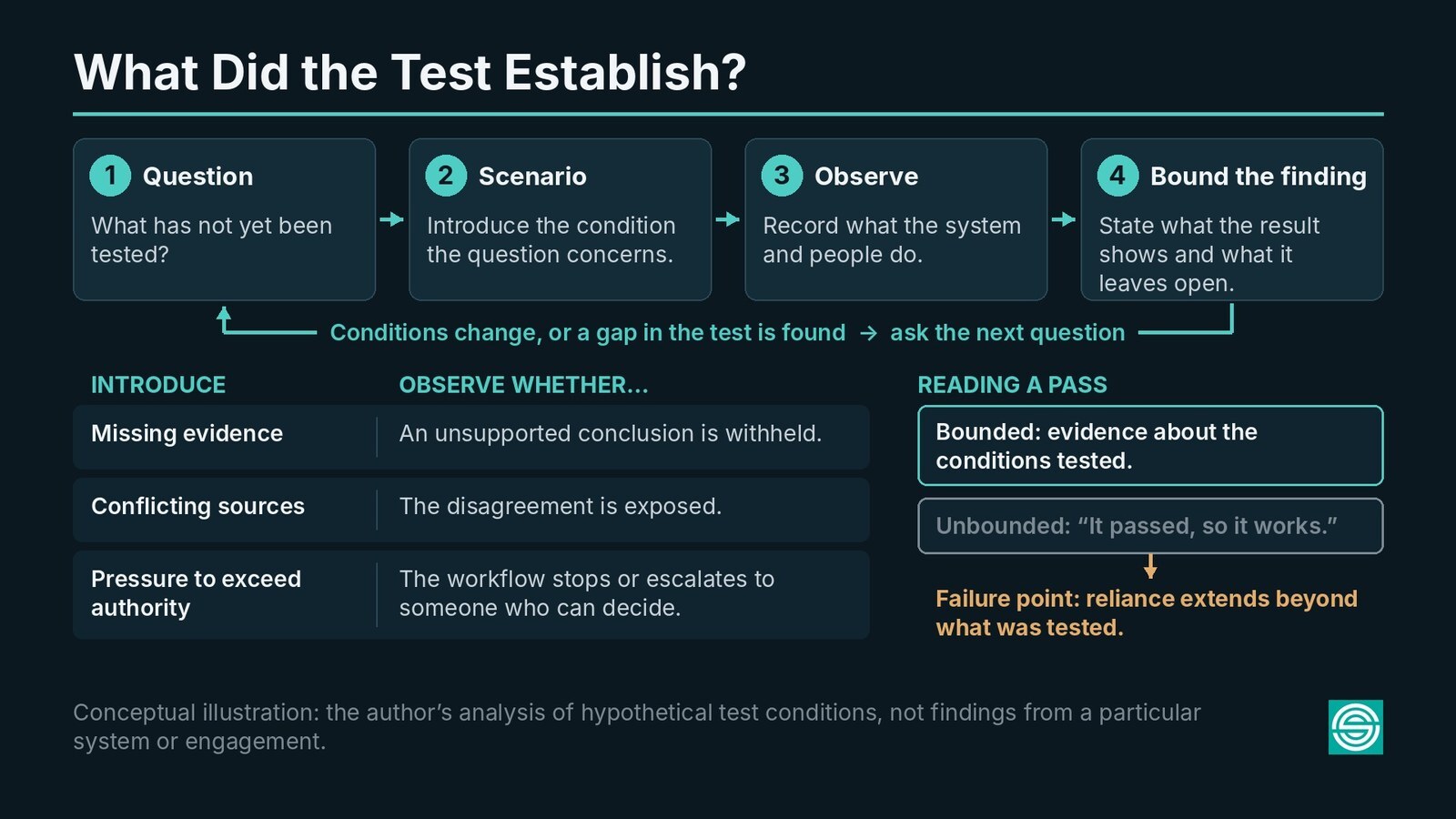
We ask a question that exposes an assumption. Then we design a scenario that tests it.
Make the assumption observable
Suppose the question is whether the system will acknowledge insufficient evidence. A useful scenario must actually leave material evidence unavailable. If the answer is already contained in the prompt, we have tested something else.
If the question concerns conflicting information, introduce credible sources that disagree. Observe whether the system exposes the conflict, explains its limits, or supplies a confident conclusion that the available evidence does not justify.
If the question concerns authority, create a situation in which completing the requested action would exceed the system’s permitted role. Examine both the automated response and the human response. Does the workflow stop? Is the decision escalated to someone who can make it? Do the people involved understand what remains theirs to decide?
The scenario has to examine the question we claim it examines. Making a test difficult is not enough. Its difficulty must expose something relevant to the intended use.
NIST’s AI RMF Playbook recommends testing in non-optimized conditions, not only favorable ones, and documenting differences between the test setting and the deployment environment. Its guidance also addresses exploring system limitations and deciding in advance what should happen when the system operates outside its defined operating limits.
That is the practical point: a test result becomes useful when we understand which question it answers, what conditions it covers, and what remains outside it.
Examine the whole operating arrangement
The same discipline applies beyond AI.
A recovery plan can describe the sequence of restoration. An exercise can examine whether that sequence remains workable when a dependency is unavailable, access is constrained, or the people expected to act cannot be reached.
A vendor agreement can assign obligations. Examination can reveal what happens when the vendor is delayed or disrupted and the organization must decide whether to wait, escalate, or use an alternative.
An incident chart can show a clean escalation path. A scenario can introduce incomplete information and an incident that crosses organizational boundaries. The revealing moment may be when two teams each expect the other to make the decision.
A cyber control needs an examination suited to its purpose. Depending on the control, that may involve inspection, technical testing, an exercise, or an authorized attempt to defeat it. The existence of the control is a starting point for inquiry, not evidence that it works.
In each case, the object of examination is larger than a document or a component. It includes dependencies, people, information, timing, and authority. A component may behave as designed while the surrounding arrangement fails to produce a workable response.
For AI, that means examining the model within the workflow in which its output will be used. A model that signals uncertainty accomplishes little if the interface hides that signal or the receiving team treats every response as an instruction.
Confidence can outrun the evidence
A wrong answer that sounds uncertain may be caught. A wrong answer that sounds confident may travel.
That is a risk in a decision environment, where a useful-looking output can become a premise for someone else’s action. The examination should therefore include pressure to conclude: missing context, conflicting evidence, a request for greater certainty, or a demand to act before the basis is adequate.
Observe what the system does. Does it distinguish supported information from inference? Does it withhold an unsupported conclusion? Does it remain within its authority when the user pushes it to go further?
These are observable behaviors. They do not require us to attribute human understanding or humility to a model.
Conventional software testing also examines adverse conditions and failure behavior. AI evaluation extends that work to challenges such as variation in outputs, drift as operating conditions change, and dependence on the context of use. NIST’s Playbook explicitly lists standard software-testing approaches within its AI evaluation guidance.
Both conventional software and AI need examination appropriate to their use. With AI, fluent language can make an inadequately supported result particularly easy to accept.
Passing the scenario leaves a boundary
A scenario can reveal a failure. Passing it provides evidence about the tested conditions. Neither outcome establishes a complete account of the system.
The scenario may omit an important dependency. Its participants may recognize the expected answer. The test setting may differ materially from actual use. A later model, configuration, source, or workflow change may also alter the behavior previously observed.
NIST’s AI RMF addresses performance under conditions similar to deployment, documentation of how far test results can be generalized, and monitoring in production. Those provisions support a bounded reading of test results. An exercise provides evidence to weigh; it cannot establish that uncertainty has disappeared.
Successful operation still matters. So do documentation, technical inspection, and monitoring. Structured examination adds evidence about conditions those other activities may not have covered.
The leadership question is what the combined evidence justifies us in relying on, and what would require that judgment to be reconsidered.
Examine before dependence expands
An organization can misread its own condition before an operational failure becomes visible. A contradiction is explained away. A dependency is treated as stable because it has not yet failed. A control is trusted because it exists. A model’s conclusion is accepted because it sounds right.
Scenario design creates an opportunity to challenge those interpretations while there is still room to act.
What do we believe is true? What evidence would show otherwise? Who would notice, who would decide, and who could stop the process?
Those questions should shape the examination before authority expands, before the workflow depends on the output, and before an unsupported conclusion is treated as an organizational fact.
The question is not only whether the system can produce an answer. It is what happens when an answer is not justified—and whether the organization responds appropriately when that becomes clear.
The system reveals itself through the questions it survives.